AI procurement agents are programs that buy parts for a buyer. They read the BOM, look up every part, compare offers and prepare the order. For a distributor this means: the first one to read your offer is often a machine. If it cannot read your price, stock and lead time, you are not in the comparison.
What is an AI procurement agent?
An agent does a whole task, not just one answer. A chatbot answers a question and then forgets it. An agent keeps working on a job until it is done.
In a SupplyChainBrain article, Denis Rasulev describes what this looks like in purchasing. Agents create purchase orders, check invoices, watch contract dates and flag prices that look wrong. A person sets the limits. The agent works inside them.
Electronics has its own example. In January 2026 Luminovo launched ElectronicsGPT, an agent for electronics procurement. It finds parts and alternatives, pulls datasheets and runs availability alerts, according to EMSNow. It is free to use. So any buyer can try it today.
Why are buyers using agents now?
Because they have more work and not more people. The Hackett Group expected procurement workloads to grow by 10% in 2025, while budgets grew by only 1%. 64% of procurement leaders expect AI to change their jobs within five years (Hackett Group).
Source: The Hackett Group, 2025
Agents take the work that repeats every day:
- checking stock for each line of a BOM
- collecting quotes
- comparing lead times
- chasing the parts that are short
That is most of a component buyer’s week. So agents will not arrive with a big launch. They will arrive one task at a time, inside the tools your customers already use.
What changes for you as a distributor?
The decision is made before anyone writes to you. An agent compares the offers it can read as data, right now. An offer that comes later by email is too late.
- Buyer loads a BOM with 400 lines
- Agent checks every line it can read
- 12 short lines found, alerts set
- Draft order is ready
- Spreadsheet quote arrives by email: too late
Example from the article
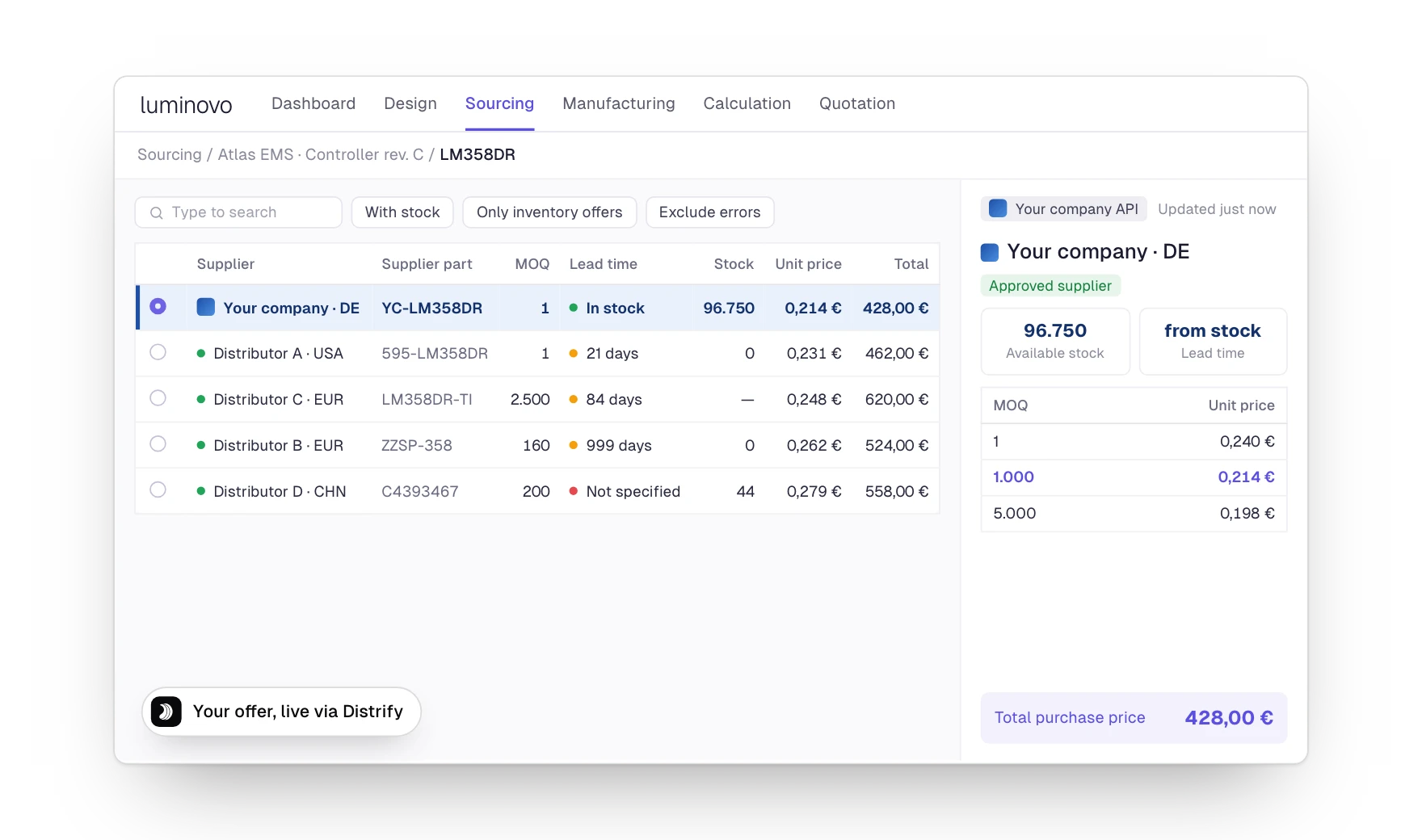
Here is a typical Monday. A buyer at an EMS company loads a BOM with 400 lines into a sourcing tool. The agent checks every line against the sources it can reach. It prices the build, finds twelve short lines and sets alerts for them. By noon there is a draft order.
The distributor whose stock and price were visible in that tool is in the order. The distributor who sends a spreadsheet on Wednesday may have the better price, and still miss the order.
Three old habits stop working:
- The weekly stock list: by Wednesday it shows stock you no longer have.
- The PDF price list: an agent cannot tell which price is for which customer.
- The quote by email: it arrives after the comparison is done.
What does an agent need from you?
Four pieces of data, in the place where the agent looks. Most distributors already have the data in their ERP:
- Stock per manufacturer part number, updated hourly, not weekly.
- The price this customer pays, at the quantity they need.
- The lead time for parts that are not on the shelf.
- Clean part numbers, so the agent matches your line to the BOM.
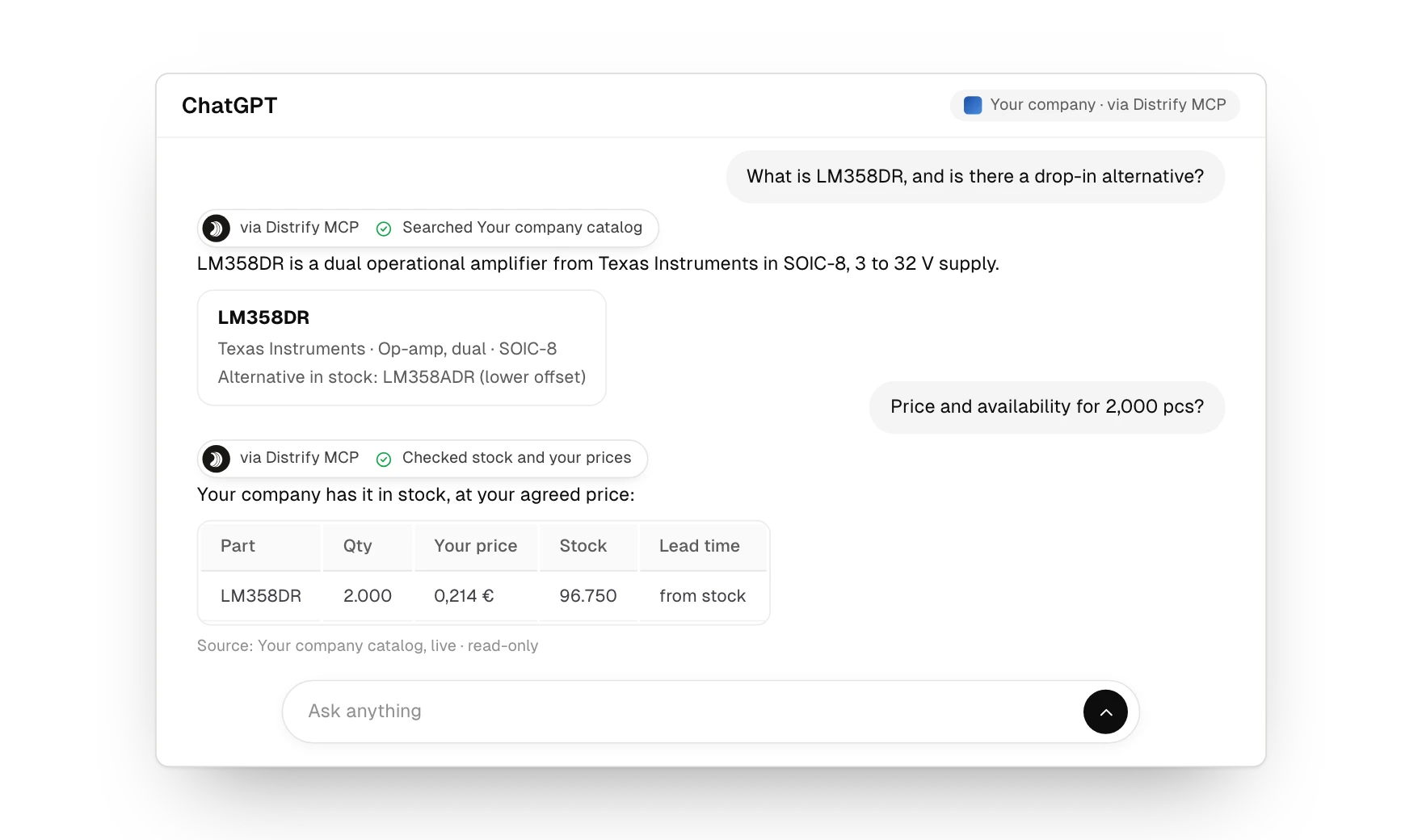
The place matters as much as the data. Good data in a file nobody connects does not help. The agent works inside a tool: your customer’s ERP, an RFQ tool, a marketplace or an AI assistant. Your data has to be there.
Who stays in control?
People do, on both sides. Buyers set limits for their agents and approve big orders themselves.
You need the same rules. You decide which customers see your data and which price each of them sees. No customer sees another customer’s price. Nobody outside can change anything in your system. And for quotes your team still sends, a person checks each one before it goes out.
What should you do first?
Check what an agent sees today. It takes one afternoon:
- Ask your five biggest customers which sourcing tools they use.
- Search twenty of your best-selling part numbers in those tools and on Octopart.
- Check three things for each: is your stock there, is it current, is the price right?
Whatever is missing is the first channel to connect. One channel that agents can read is worth more than a perfect price list that only people open.
At Distrify we connect distributors to exactly these channels. If you want to see how that works, start with RFQ tools or AI assistants.